Seminary Co-op · Chicago, Illinois
Seminary Co-op, Chicago: one paragraph a week, and the dogs next door
A close reading of six issues of the Front Table Newsletter, September 23 to October 29, 2026, and four issues of its sister store's monthly, July to October.
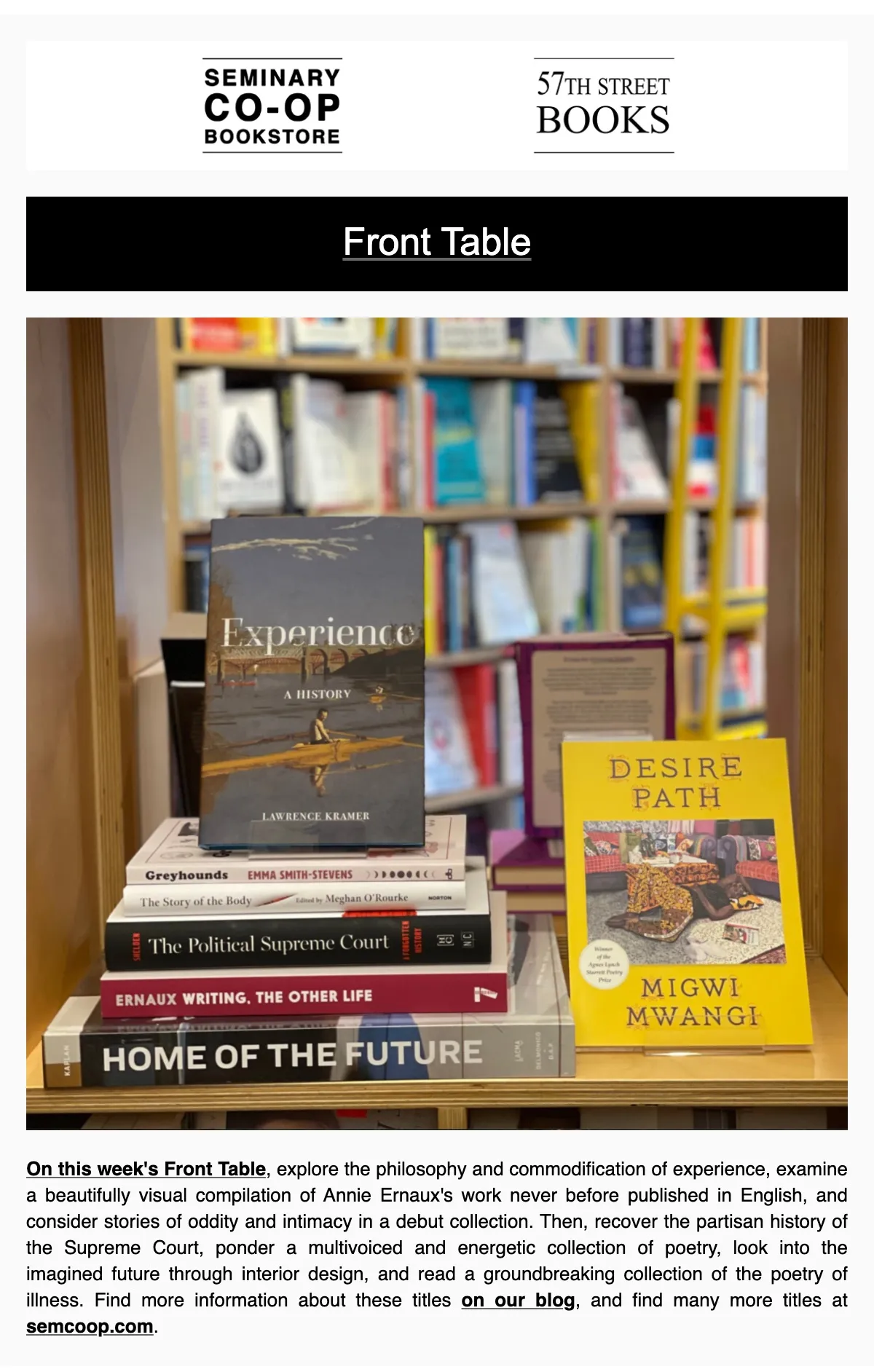
The Seminary Co-op Bookstore is a unicorn: a nonprofit academic bookstore across the street from the University of Chicago with a backlist inventory that is legendary among people who care about backlist inventories. At its heart is a front table which feels like the whole current of contemporary thought for a given week frozen into a map, ready for you to chart your course through it. Walking in is an experience.1
The newsletter is a meager representation of that, and it’s worth being plain about it before saying what’s good. It’s weekly, Wednesday or Thursday afternoon, sent from a role address in an institutional “we.” The subject line is a list of three or four things ending ”+ New Books & Events!” Most of the email is standing sections that repeat word for word from week to week: a ticket block for the same event five issues running, a discount for Obama Presidential Center visitors, an invitation to the Lit Circle, a footer of links to the staff recommendations, the Front Table blog, the archive and the Open Stacks podcast. Nobody signs anything. Nobody recommends anything in their own voice. The events, which in September were nine text cards in a fixed formula (“X will discuss Y. A Q&A and signing will follow the discussion”), became image grids in October, so the email now says less than it did. The Co-op’s writing lives in the store (and in its missed-by-me podcast). The email is the pointer.
Except for one paragraph.
The Front Table paragraph
Every issue opens with it. One paragraph, eighty to a hundred words, touring that week’s front table as a chain of imperatives, and never naming a single book:
On This Week’s Front Table, embark on an uncanny and entertaining expedition through the animal kingdom through the lens of the Surrealism art movement, be immersed in poems and essays illustrating Black legends and white myths, and dive into an unconventional atlas of the night sky. Then, examine the blueprints that expose the American immigration system, enjoy a rapturous ode to life from a decorated poet, analyze a perceptive portrait of Saudi Arabia’s complex and evolving story, and relish in an inventive road-trip novel, told by a woman longing to start anew.
Seven titles, two sentences, “Then” as the hinge, and a link to the blog where the books are named. It reads as a riddle, whatever it was meant as. I found myself guessing (the Surrealist bestiary, the Saudi portrait, the atlas of the night sky) and clicking through to check, and I suspect a Co-op regular does the same, because the pleasure is in already half-knowing. The verbs do the work clearly labeled covers would do anywhere else: embark, examine, ponder, interrogate, relish. Across six weeks the form never breaks, and it never names a book.
What it stands for is the point. The Co-op’s front table reads, to me, like a weekly argument about what matters right now, ranging across every discipline the university teaches, and the paragraph is that argument compressed to a single breath. Reindeer and the war on terror and flash fiction. Alchemy and logistics networks and William Morris’s gardens. A paragraph this abstract works here because the readers already know what the table looks like; anywhere the table wasn’t already in their heads, it would be a riddle with no prize.
What it costs
The paragraph is the only writing in the email, and a reader who doesn’t click gets no titles, no covers (except where identifiable in the photo), no bookseller, no reason beyond habit. The device that makes the newsletter distinctive also makes it thin.
Then you click, and here is the heartbreak. The Front Table post on the blog, the place the riddle resolves, is the seven titles with their publisher copy pasted beneath them. No bookseller’s name. No sentence about why these seven are on the table together this week, which is the only question the table raises and the one thing publishers can’t answer. The table makes the argument. Nobody writes it down. The eighty-word paragraph in the email is the only original sentence in the whole chain, and it’s the one that names nothing.
So the gap a regular notices isn’t just between the email and the store. It’s between the table and any account of it anywhere. A selection this considered goes out each week described by the people who published the books.
The sister store
You can’t talk about the Co-op’s newsletter without the other one. 57th Street Books is the Co-op’s general-interest sibling a few blocks away, and once a month, on the first Saturday morning, the same Mailchimp account under the same institutional sender puts out A Young Person’s Guide to 57th Street Books. The title is a Britten joke, which is the Hyde Park wink that tells you who’s writing. It is a totally different entity.
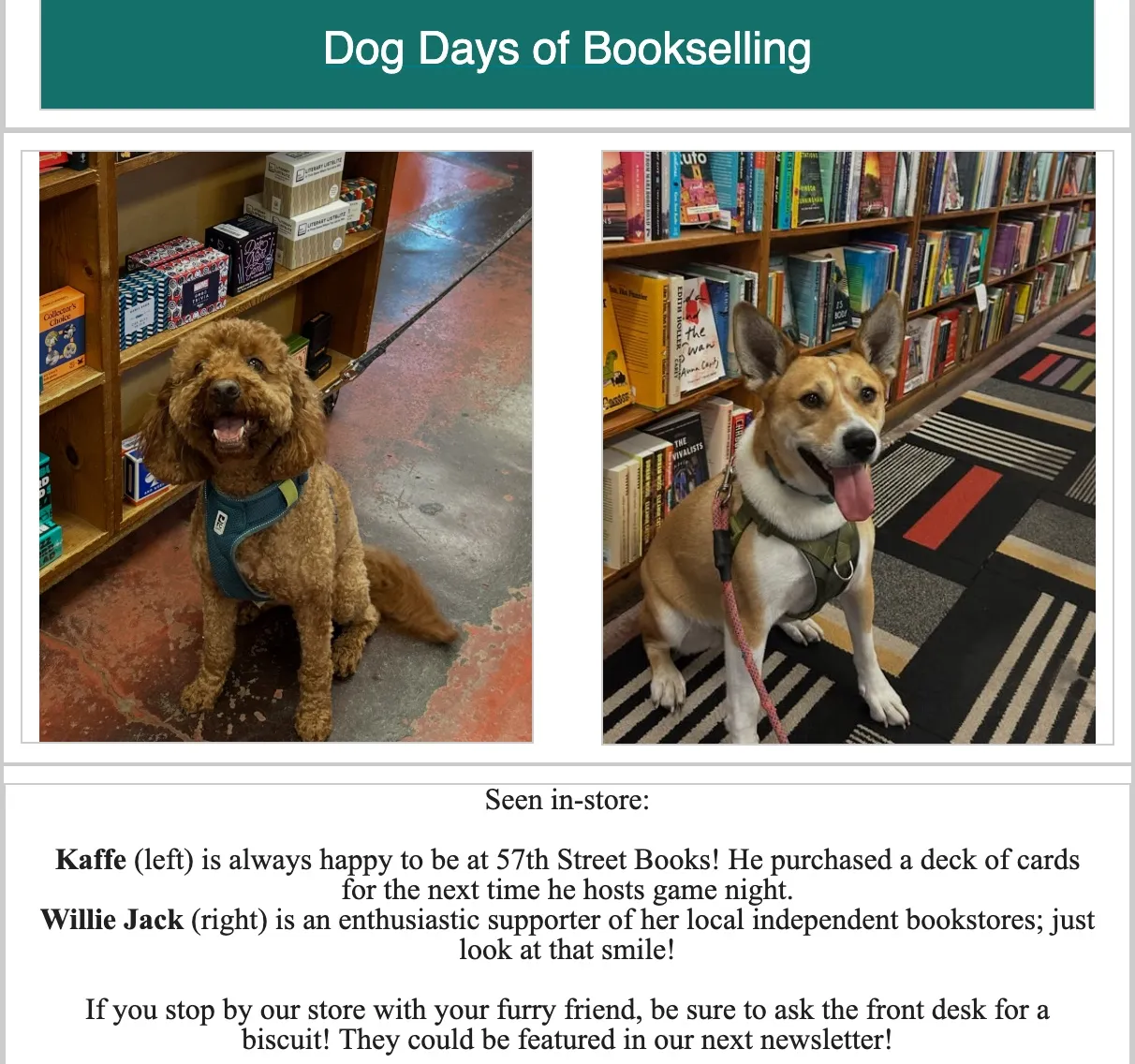
There’s a table of contents. Then Sunday Storytime with Franny, who “not only reads books, both new and old, but invites kids to participate in sing-a-longs, finger plays, and if you should find that your tots are particularly restive, ends every storyhour by singing them to sleep.” Then Books for Young Readers, five to eleven titles sorted by age band (picture books, graphic novels, middle grade, young adult), each with publisher, author and illustrator credited and the on-sale date noted when the book isn’t out yet. In July, a Fourth of July Syllabus for young readers: voting rights, protest songs, labor history, one per age band. A heading that reads “Upcoming Events for the Adults.” And at the bottom, every month, Dog Days of Bookselling: two photographs of dogs in the store, with captions.
The dogs are where the person is. “Riley, our Front Table’s most dogged browser, though she always requests we stock a few more books on fetch.” “Cherie, planted in front of social sciences! If you want to read about current events, you might need to give her a treat.” “Annie Hall, the companion of Co-op floor manager, Wren, making an impassioned stand in favor of dog treats at the Co-op as well as 57th.” Somebody is having fun, and it’s the only place in either newsletter where that’s true. Bring your dog, ask the front desk for a biscuit, and it might be in next month’s issue, which is also the only reader participation in the whole operation.
The book descriptions are still publisher copy, same as the Front Table blog. What’s different is the structure around them. The age bands turn a list into a guide, which is the service a children’s section exists to provide, and the syllabus does the thing the Front Table paragraph refuses to do: it tells you why these books are together. Compiled, but compiled toward a use a parent can act on.
So the sister newsletter makes the point sharper, not softer. One institution, one account, two emails. The flagship withholds and compiles. The sibling sings tots to sleep and captions dogs. The Co-op has plenty to say. Its front table proves that. But the books get a list, and the dogs next door get a story.
The sentence nobody wrote
Any store with a front table it’s proud of can borrow the paragraph: one a week, written as a tour rather than a list, with the books named a click away. It works because it points at something that happens in the store every week, and that’s a better job for a newsletter than standing in for the store.
The Co-op also shows which half is missing. Where the click lands, write the sentence the Co-op doesn’t: why these seven, together, this week. That sentence is the whole value of a front table, and nobody but a bookseller can write it.
From next door, take the age bands, the syllabus, and a standing feature at the bottom where somebody gets to be funny. Dogs are optional. The permission isn’t.
The table itself stays in Hyde Park. Seven books that together read as a map of contemporary thought are the product of an institution, a university, a buying staff and sixty years. The paragraph is the shadow it casts in your inbox. The thing itself, you have to go and see.
Footnotes
-
I first walked into the Seminary Co-op in my early twenties, when the store was still a warren-like maze of rooms and shelves. I remember the abundance, the seriousness, the atmosphere of limitless curiosity, and the intimidating evidence of everything I hadn’t yet read. I encountered it at exactly the right age. It changed what I thought a bookstore could be.
So I may be asking something unreasonable of its newsletter. I know what it feels like to walk into that store, and I want some of that experience to reach me in my inbox. Perhaps that’s more than a newsletter can reasonably deliver. ↩
Sources
Both newsletters go out from one Mailchimp list and share a public archive. The July and August Guides are further down it.
Front Table Newsletter
- Fall Coursebooks Have Arrived! + Tickets On Sale Now for Marlon James, Emily St. John Mandel, John Scalzi and More + New Books & Events!
- Get Your Tickets for Eric Idle, Ayad Akhtar and More + New Books & Events!
- Banned Books Week, John Scalzi, Rebecca Neusteter, + New Books & Events!
- New Fall Lecture Featuring Geoffrey Stone, Midwest Books to Prisons Partnership Extended + New Books & Events!
- A Conversation with Adrienne Young, NaNo 2.0, Holiday Bookstore Trolley Tickets are Now Live! + New Books & Events!
- Dominic A. Pacyga at Robie House, Will Quam, Jane Hamilton, Storytime with Doctor Waffle + New Books & More Events!
A Young Person’s Guide to 57th Street Books
- A Young Person’s Guide to 57th Street Books - July 2026
- A Young Person’s Guide to 57th Street Books - August 2026
- A Young Person’s Guide to 57th Street Books - September 2026
- A Young Person’s Guide to 57th Street Books - October 2026