Point Reyes Books · Point Reyes Station, California
Point Reyes Books: the fog is here
A close reading of five monthly issues, June to October 2026.
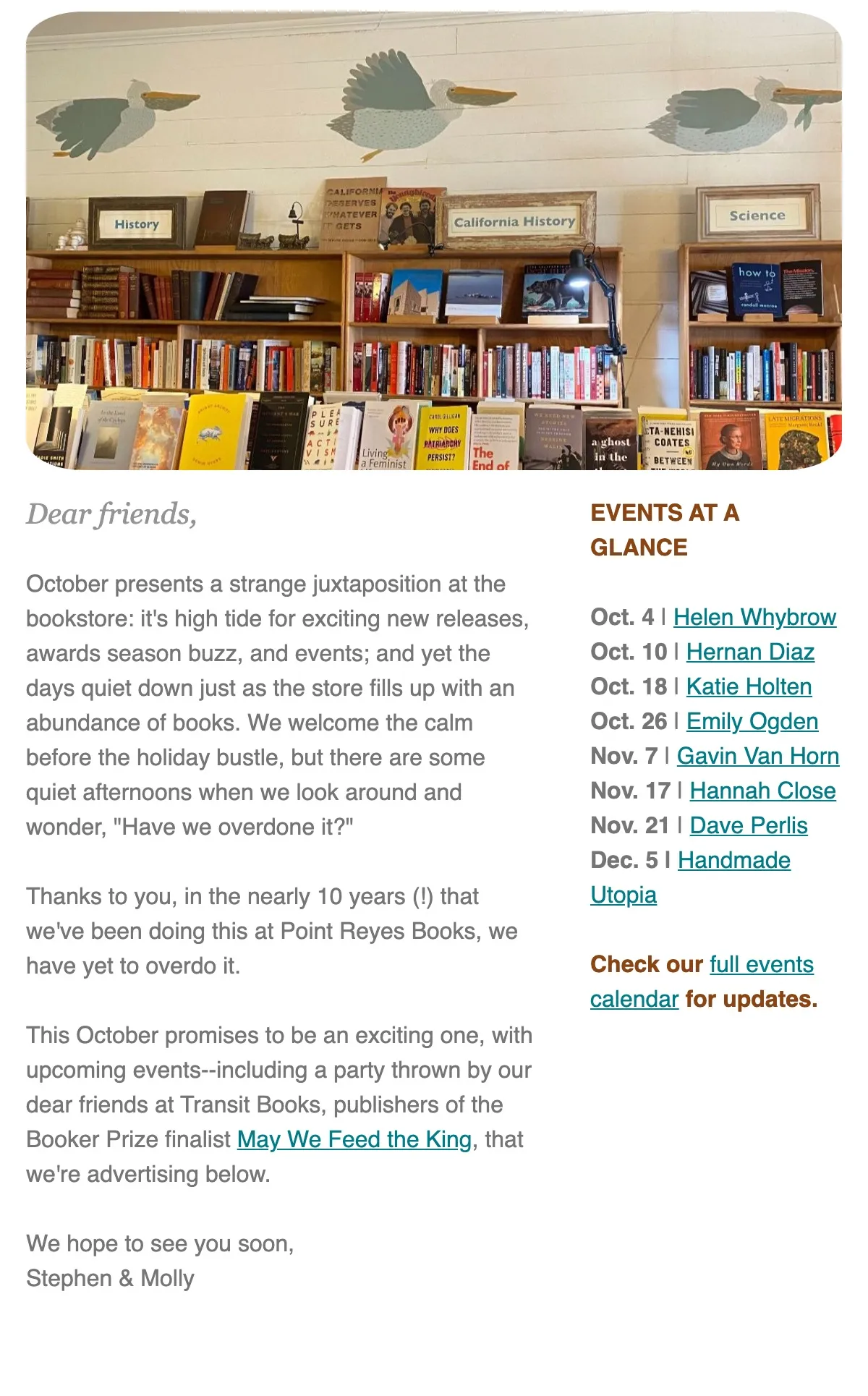
Point Reyes Station is a town of a few hundred people at the edge of a national seashore, an hour north of San Francisco. Point Reyes Books has been there since 2002, when Brown Study Bookshop was renamed, and has belonged to Stephen Sparks and Molly Parent for nearly ten years (they also operate Wayfinder Bookshop in Fairfax). Its newsletter comes once a month, in the first days of the month, around one in the afternoon. The subject line is always “[Month] at the bookstores.” The preheader never changes: “Book recommendations and upcoming events.”
I’ll say up front why this one matters to me. I work at a bookstore in a gateway town to a national park, and this is the newsletter I’d want ours to be. Not because it’s the most polished in this series. Because it comes from a specific place, and what makes the place worth visiting is the same thing that animates the store.
The letter
“Dear friends,” then two to four short paragraphs, signed Stephen & Molly. It rarely runs past two hundred words, and it’s written from a window. “From our office in the Emporium Building, I look out and see that summer is officially underway. A family with ice cream cones sits on the bench in front of the Palace Market.” The surf shop that moved into the old Zuma space. The restaurant going into the old Station House building. June: “despite the unprecedented times we’re living in, some things remain reliably true: it’s June in Point Reyes and the fog is here.” September: “try sharpening a pencil.”
The register is confidence with the volume turned down: there’s no selling, no exclamation points to speak of, no “support local,” no explaining. The closest it comes to an ask is October’s: “there are some quiet afternoons when we look around and wonder, ‘Have we overdone it?’ Thanks to you, in the nearly 10 years (!) that we’ve been doing this at Point Reyes Books, we have yet to overdo it.” And that is the entirety of the pitch. It works because it barely is one.
Events at a Glance
Before any card, a column: seven to nine dates and names, then “Later this year: Pulitzer Prize-winner Hernan Diaz, Helen Whybrow, Katie Holten and more!” and a link to the full calendar. It’s small and highly effective: a reader sees the whole season in one look and decides what to drive out for, which in a town an hour from anywhere is a decision that matters.
The program
Nearly every event is free and in a borrowed room: the Dance Palace, the Red Barn at Bear Valley, the Presbyterian church, the Pavilion in Fairfax, Zoom. Partners are named each time: the Point Reyes National Seashore Association, the Mesa Refuge, Transit Books, Emergence Magazine, the Dance Palace itself. Stephen interviews the authors and is named in the card as “bookstore owner Stephen Sparks.”
And the list. M. Kat Anderson, whose Tending the Wild is a foundational text, at the Red Barn. Robert Hass and Brenda Hillman together at the Dance Palace. Helen Whybrow’s shepherd memoir. Katie Holten’s tree alphabet. A Sensoria anthology with David George Haskell’s blurb on it. A Hebridean island waybook over Zoom at noon. Hernan Diaz as the literary headliner, Jared Huffman as the civic one, a cultural history of Marin called Morning in Marin: Zen, Drugs, and Ewoks. A store in a town this size runs a season of nature-and-letters programming most cities don’t, and the newsletter is its calendar.
This is exactly the programming I would do if I could snap my fingers and have programming. That’s pure admiration but comes with a caveat. Marin County and my own Clallam County are demographically worlds apart. The seashore brings a certain visitor, and the hills behind the town hold a certain resident, and the Dance Palace fills for a poetry reading in a way I can’t assume anywhere else. The model is portable. The audience that makes it pay off isn’t.
The cards
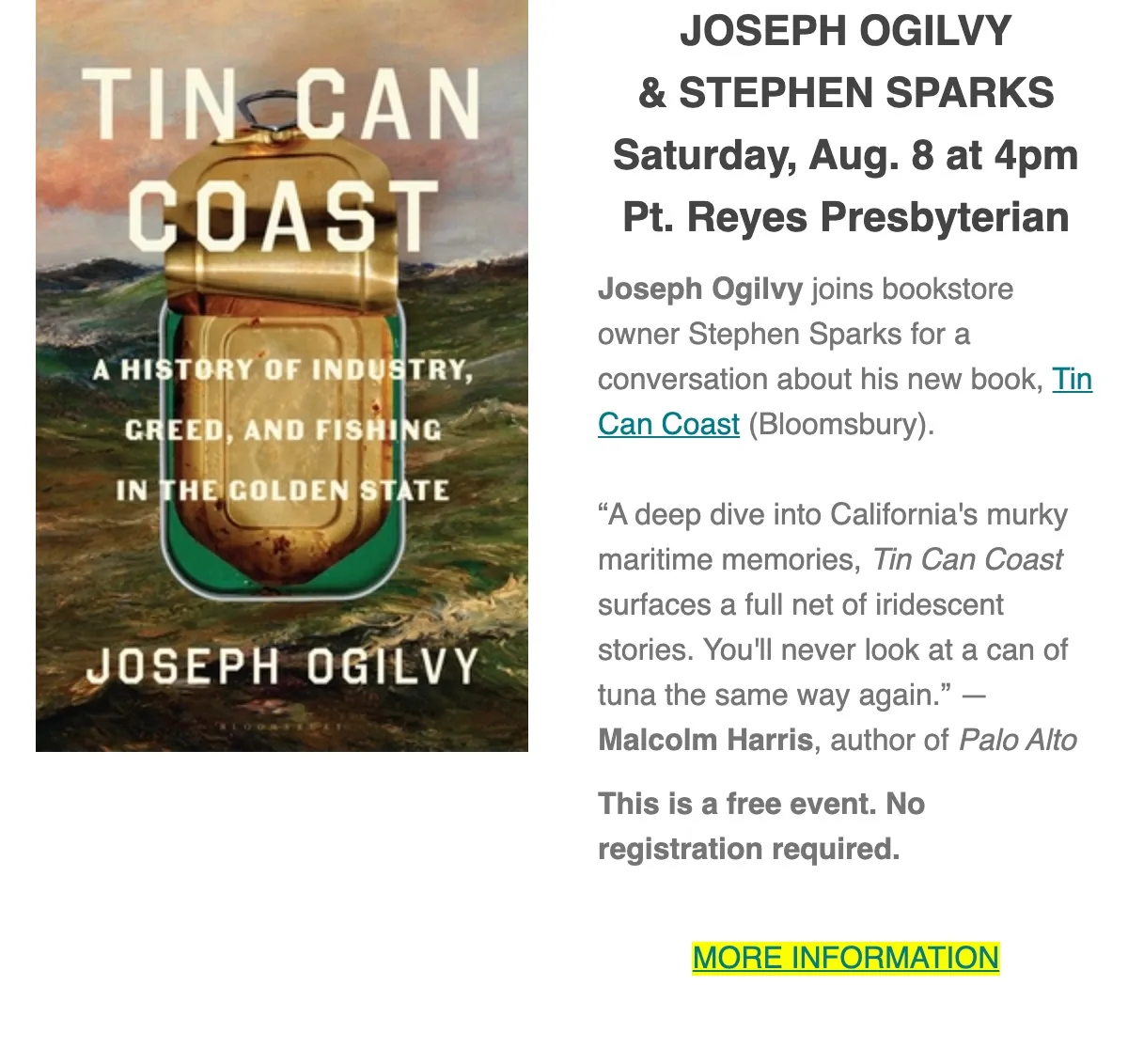
A fixed form. Name in caps, day and time, venue, one sentence that names the book and the press in parentheses, one blurb, and the line that closes nearly every one: “This is a free event. No registration required.” The blurbs are chosen well: David Mitchell on Ply, Max Porter on Holten, Peter Coyote on Perlis. The store’s own voice stays in the letter and lets the publishers speak in the cards, which is the right division. A card that said less would lose the book; a card that said more would start to sound like marketing, and this newsletter is conspicuously not interested in marketing. It’s interested in the books and the conversations.
Three covers and no sentences
The staff picks are three cover images under a heading, and nothing else: no bookseller’s name, no sentence. The heading often outlasts its sell-by date (“JULY STAFF PICKS” in the August issue, “SEPTEMBER” in October). The covers click through to the store’s product pages, so the recommendations exist, but the “book recommendations” the preheader promises every month arrive in the inbox as three jackets with nobody in them. For a store whose owners write this well, that’s the missed opportunity.
Cards can repeat verbatim for months. About eighty percent of images have empty alt text, so the picks and the covers don’t exist for a screen reader or an image-blocking inbox. The August issue is 440 words and mostly reruns of July.
None of this costs them much with their readers. It’s the difference between a newsletter that’s very good and one that could be twice as special if they wanted to or had the capacity: a sentence per pick, a line about why this author in this room. The sentences are easy. Finding room for them in a month that already has a letter, a calendar and a season of events to run is a question of capacity, not craft, and the two people who write the letter are the two people who’d have to find it.
What’s portable, and what isn’t
Portable: the Events at a Glance column. The card form with its closing line. The letter from a window, two hundred words, with the weather and the neighbors in it. Free events in borrowed or shared rooms with the partner named every time. Letting the publisher’s blurb carry the card and keeping your own voice for the letter. Naming the owner as the interviewer.
Portable with a caveat: the program itself. The template for a gateway-town store is right here, nature and letters, the park association as a partner, the hall down the street as the venue. What has to be tested locally is whether the room fills.
Not portable: the place. The fog, the seashore, the Emporium Building, a town that’s an hour from the city and knows it. The newsletter is good because it’s from there and doesn’t pretend otherwise. It makes me want to go, every month, which is the only test a bookstore newsletter in a town of a few hundred people needs to pass.
A bookstore I’ve never visited
I talked about this store enough that my wife bought me a Point Reyes Books t-shirt, and it’s perhaps the favorite, most-worn one in my closet. She also gave me a subscription to their Thinking Like a Mountain series, which has put great books in my hands. One of them was the little Penguin UK paperback of the book the series is named for; tracking down its distributor changed some of the buying philosophy at my own store. I now use their calendar to make my own reading decisions and to choose which galleys to request.
Sources
Each issue links to the web version on the store's public Mailchimp archive.